
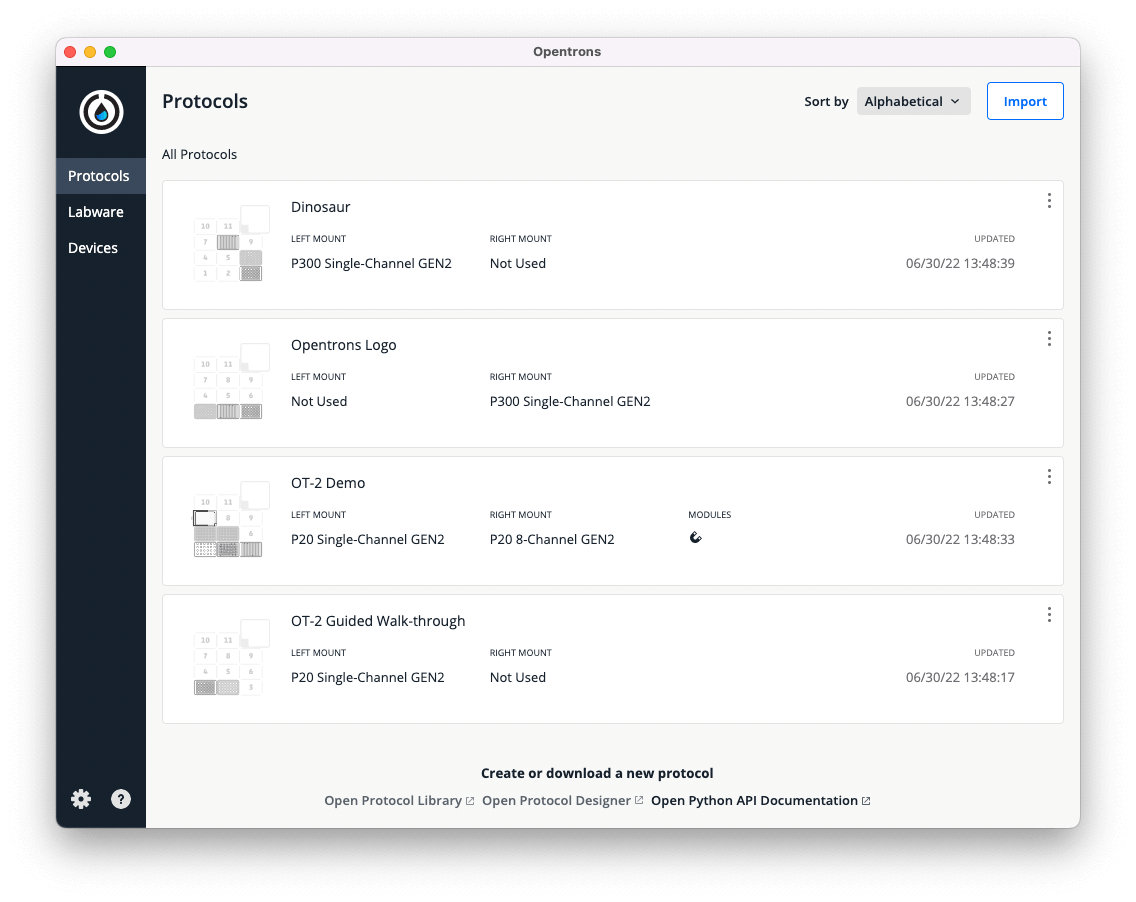
The Opentrons API serves as the core software interface and Python API for programming and controlling Opentrons liquid handling robots, including the OT-2 and Flex platforms. It provides a robust, programmatic foundation for automating complex laboratory protocols across various scientific disciplines. Researchers can leverage this API to define precise robotic movements, manage liquid transfers, and dictate experimental parameters with high fidelity, transforming manual laboratory work into scalable, reproducible, and efficient automated workflows.
This tool finds extensive application in domains requiring high-throughput and meticulous liquid handling. For instance, in analytical chemistry and clinical diagnostics, it facilitates the automation of procedures like Solid-phase Extraction (SPE) in 96-well plate formats, drastically increasing sample processing capacity. It is also critical for ensuring the accuracy and consistency of basic lab techniques, such as the precise execution of various pipetting methods and the calibration of micropipettes.
Beyond routine tasks, the Opentrons API is instrumental in advanced research. It enables the automation of intricate experimental setups, such as the robotic dispensing required for the crystallization of membrane proteins in viscous lipidic cubic phases, where manual pipetting is challenging and prone to error. In synthetic biology and genetic engineering, it empowers large-scale studies like Adaptive Laboratory Evolution (ALE), significantly boosting experimental throughput and statistical power by automating countless iterative cycles. Furthermore, within the broader field of laboratory automation, this API acts as a central component for integrating and orchestrating robotic systems, supporting sophisticated scheduling and execution of multi-step scientific investigations.
Tool Build Parameters
| Primary Language | Python (57.49%) |
| License | Apache-2.0 |