
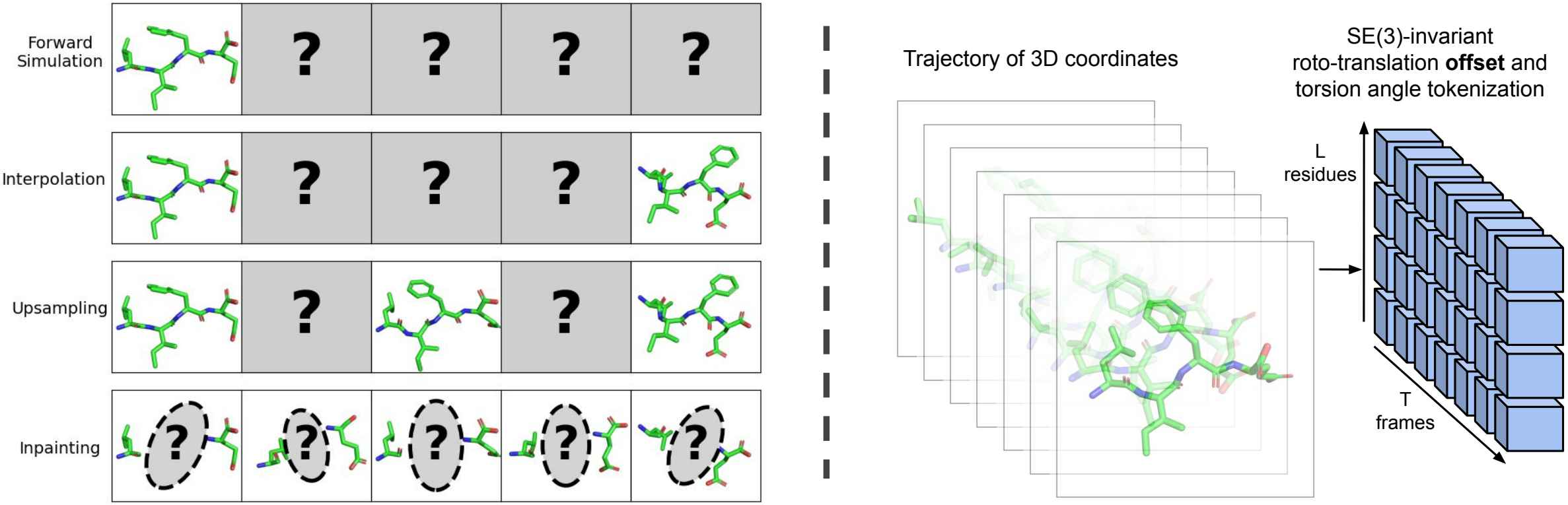
mdgen is a sophisticated generative modeling library specifically engineered for molecular dynamics (MD) trajectories. It leverages state-of-the-art machine learning techniques to synthesize realistic molecular trajectories that accurately capture the intricate statistical and dynamic properties of complex molecular systems. This capability is fundamental for advancing our understanding, prediction, and design capabilities in various scientific disciplines.
The tool finds broad applicability in critical areas such as drug discovery, materials science, computational biophysics, and synthetic biology. It can be effectively applied to problems involving de novo molecular design, such as generating novel antimicrobial compounds or therapeutic sequences by exploring vast chemical spaces and simulating their dynamic behavior. For instance, in the context of enzyme engineering, mdgen can simulate and assess the structural integrity and stability of computationally designed proteins, providing crucial validation before resource-intensive experimental synthesis. In pharmaceutical research, it enhances Quantitative Structure-Activity Relationship (QSAR) studies by furnishing a rich, dynamic dataset of simulated molecular interactions, aiding in lead optimization. Furthermore, mdgen is invaluable for analyzing the nuanced dynamics of biological systems, such as the stepping mechanisms of motor proteins, where it can generate simulated trajectories to validate models derived from noisy experimental data. It also contributes to understanding the statistical properties of chaotic attractors in complex physical systems by providing generative models that encapsulate underlying dynamic principles.
Practical applications and use cases for mdgen include significantly accelerating drug discovery pipelines by generating diverse molecular structures and simulating their interactions with biological targets, thereby identifying promising candidates more efficiently. Researchers can utilize mdgen to thoroughly explore the conformational landscape of proteins, identify stable states, and predict crucial transition pathways, which is vital for elucidating protein folding mechanisms and biological function. Moreover, it serves as a powerful tool for data augmentation, generating extensive synthetic datasets to train other machine learning models or to formulate hypotheses when experimental data is limited. By producing highly realistic and statistically consistent trajectories, mdgen facilitates the development and validation of new computational models for intricate molecular phenomena, effectively reducing reliance on computationally expensive and time-consuming classical MD simulations.
Tool Build Parameters
| Primary Language | Python (100.00%) |
| Build System | None (no setup.py/pyproject; no compilation expected) |
| License | MIT |