
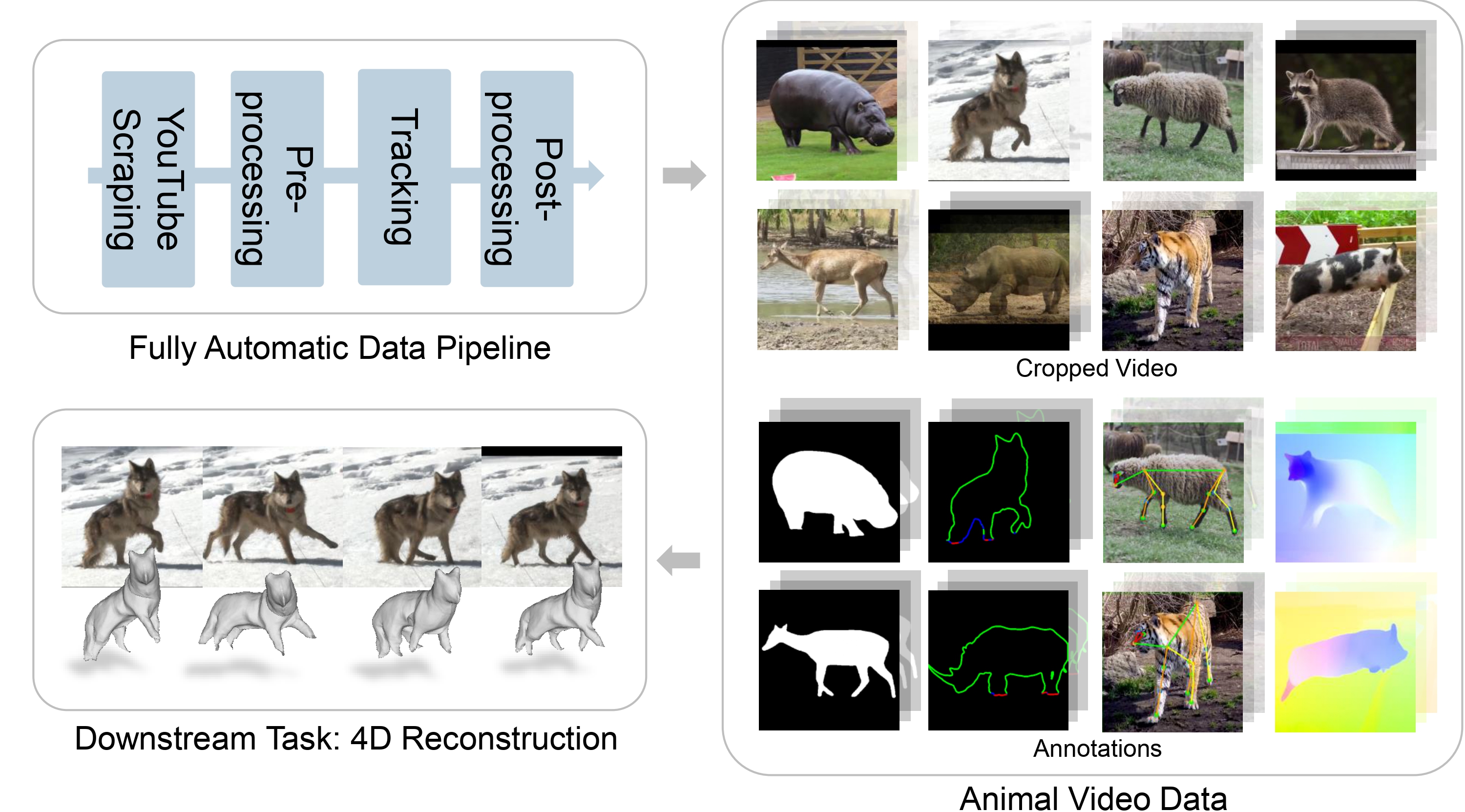
Animal-in-Motion is a sophisticated AI for Science data collection and processing pipeline engineered for comprehensive analysis of animal video data. Building upon its core function of animal pose prediction, this tool provides rich annotations including masks, keypoints, depth information, and occlusion data. This detailed output makes it exceptionally suitable for advanced applications such as 3D/4D reconstruction, precise animal tracking, and robust pose prediction across various biological research domains.
This tool finds critical application in diverse scientific fields, enabling researchers to tackle complex problems with unprecedented accuracy and efficiency. In neuroscience and behavioral biology, Animal-in-Motion can be used to extract precise kinematic motion, eye tracking, and pose estimation from video recordings, which can then be temporally aligned with neural data. This allows for detailed analysis of the cellular basis of behaviors, for instance, in designing ethical experimental refinements for studies requiring precise behavioral monitoring while ensuring animal welfare, such as reconciling scientific requirements for auditory isolation with the ethical need for social housing in song learning studies.
In ecology and environmental biology, the pipeline assists in quantifying activity patterns crucial for understanding metabolic processes. Researchers can leverage it to measure thermoregulation costs or energy expenditure by analyzing detailed movement and posture changes, improving the accuracy of allometric scaling and metabolic theory models. For biomechanics and forensic biomechanics, Animal-in-Motion offers robust capabilities for camera calibration and motion tracking, facilitating accurate 2D and 3D reconstruction for in-depth analysis of animal locomotion or injury patterns. Furthermore, the rich annotated datasets generated by Animal-in-Motion serve as invaluable resources for the development and validation of deep learning models in pose estimation, allowing for the derivation of multi-peak Non-maximum Suppression (NMS) algorithms that enforce limb-length and kinematic priors for more biologically plausible results.
Practical applications include automated high-throughput phenotyping in drug discovery or genetic studies, non-invasive monitoring of animal welfare in laboratory or natural environments, and detailed quantification of complex animal behaviors for ethological research. Its ability to process and annotate large volumes of video data autonomously significantly accelerates the pace of discovery in fields requiring fine-grained behavioral analysis.
Tool Build Parameters
| Primary Language | Python |
| License | Apache-2.0 |